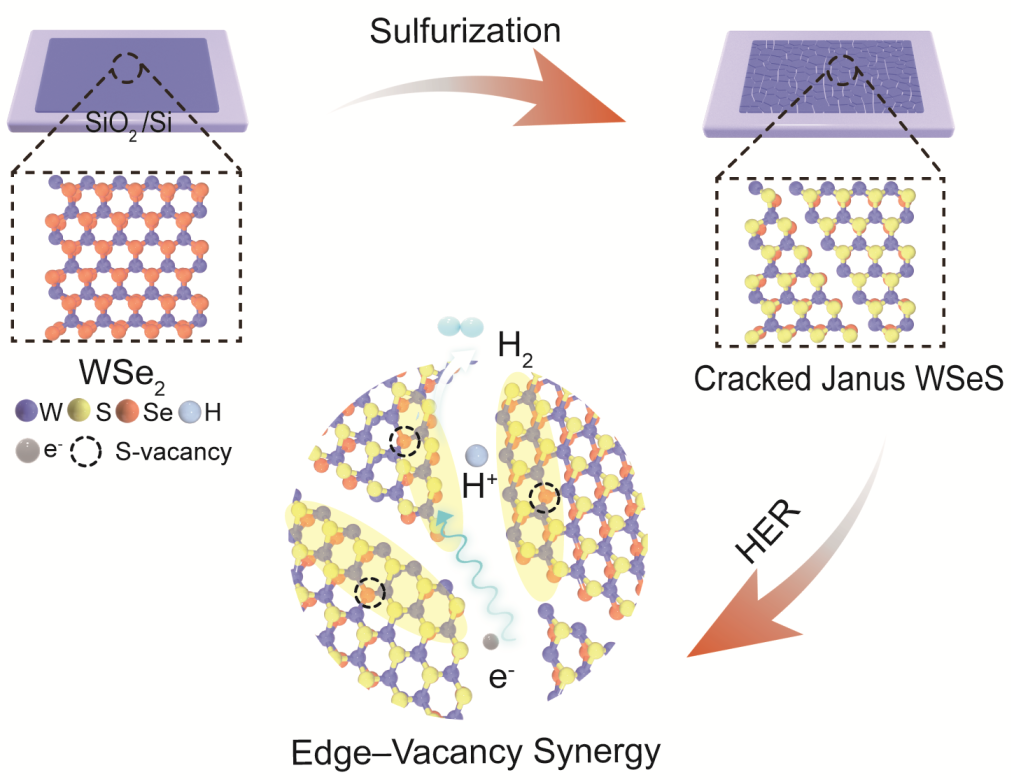
Congrats to Xinyan for his co-first authored paper “Edge-Vacancy Synergy in Cracked Janus WSeS Monolayers for Efficient Hydrogen Evolution” being accepted in Angewandte Chemie International Edition!
Janus transition metal dichalcogenides carry a built-in vertical asymmetry that benefits hydrogen evolution, yet their active edge sites remain scarce and the basal planes catalytically inert. This work reports a strain-driven crack engineering strategy for monolayer Janus WSeS: during room-temperature sulfurization of WSe2, the tensile strain from substituting larger Se with smaller S spontaneously fractures the monolayer into nanodomains, exposing crack edges at densities up to 2.06 μm μm−2. Density-of-states and electron localization function analyses reveal that the crack edges synergize with adjacent sulfur vacancies, enriching the electronic states near the Fermi level and bringing the hydrogen adsorption free energy close to thermoneutral. The cracked Janus WSeS delivers an overpotential of 214 mV at 10 mA cm−2 and a Tafel slope of 68 mV dec−1 in acidic electrolyte, together with 1000-sweep and 24-h operational stability. This structure–mechanism–activity relationship provides a generalizable strategy for tailoring edge morphology in low-symmetry 2D materials.