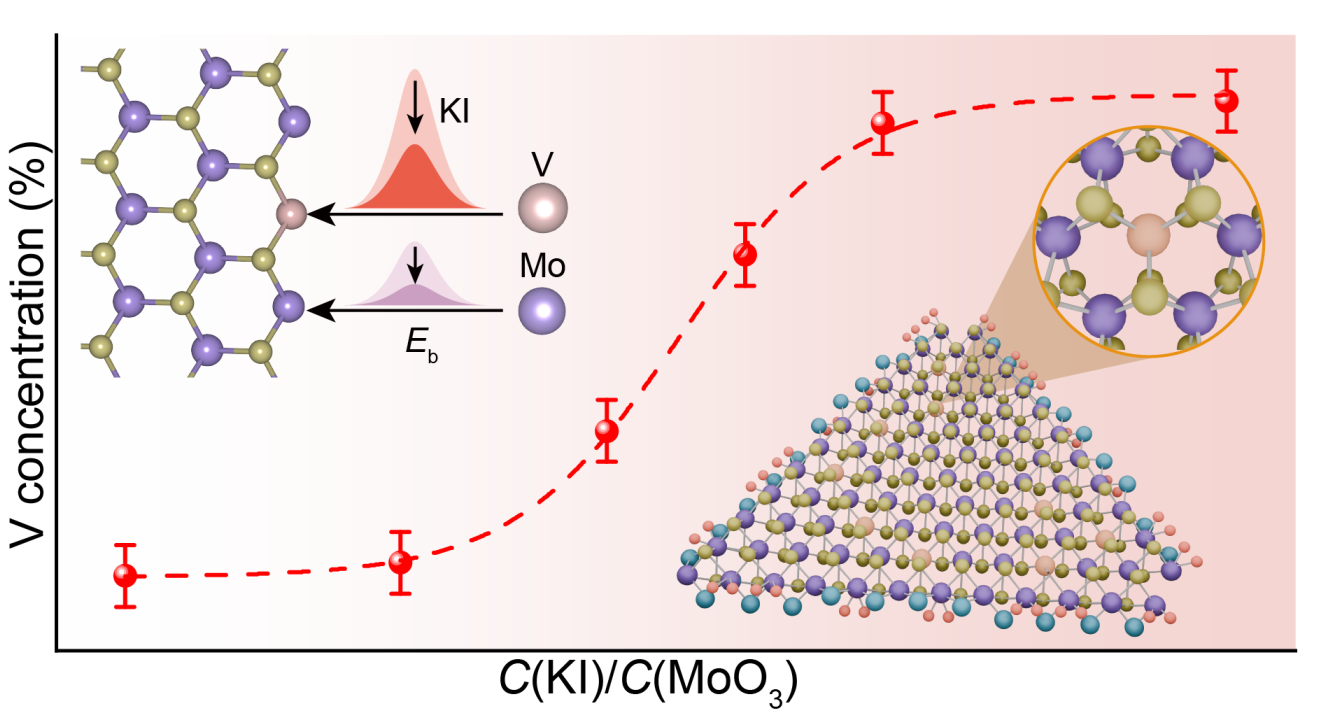
Congrats to Yuanyuan, Bin and Fei for their co-first authored paper “Boltzmann Sigmoidal Modulation of Vanadium Doping in Monolayer MoS2 by Potassium Iodide” being published in Nano Letters!
Substitutional doping underpins semiconductor electronics, but the atomic thinness of two-dimensional (2D) semiconductors rules out ion implantation, leaving in situ doping during growth as the practical route — and its governing mechanism has remained elusive. Using V-doped monolayer MoS2 as a model system, this work established a STEM-calibrated Raman probe (defect-activated double-resonance modes at 100–250 cm−1) to quantify the real dopant concentration, and found that the doping density saturates far below the precursor feeding ratio (~9% plateau despite up to 80% nominal feeding). The saturation level is tuned by the potassium iodide (KI) promoter following a Boltzmann sigmoidal law from ~4% to ~12%, which first-principles calculations reconcile with the edge passivation substitution model: iodine termination lowers the V incorporation barrier more strongly than that of Mo, activating heteroatom substitution. This iodide-activated doping paradigm advances doping theory for low-dimensional systems and charts a generalizable route to controlled heteroatom substitution in 2D semiconductors for electronic, spintronic and catalytic applications.